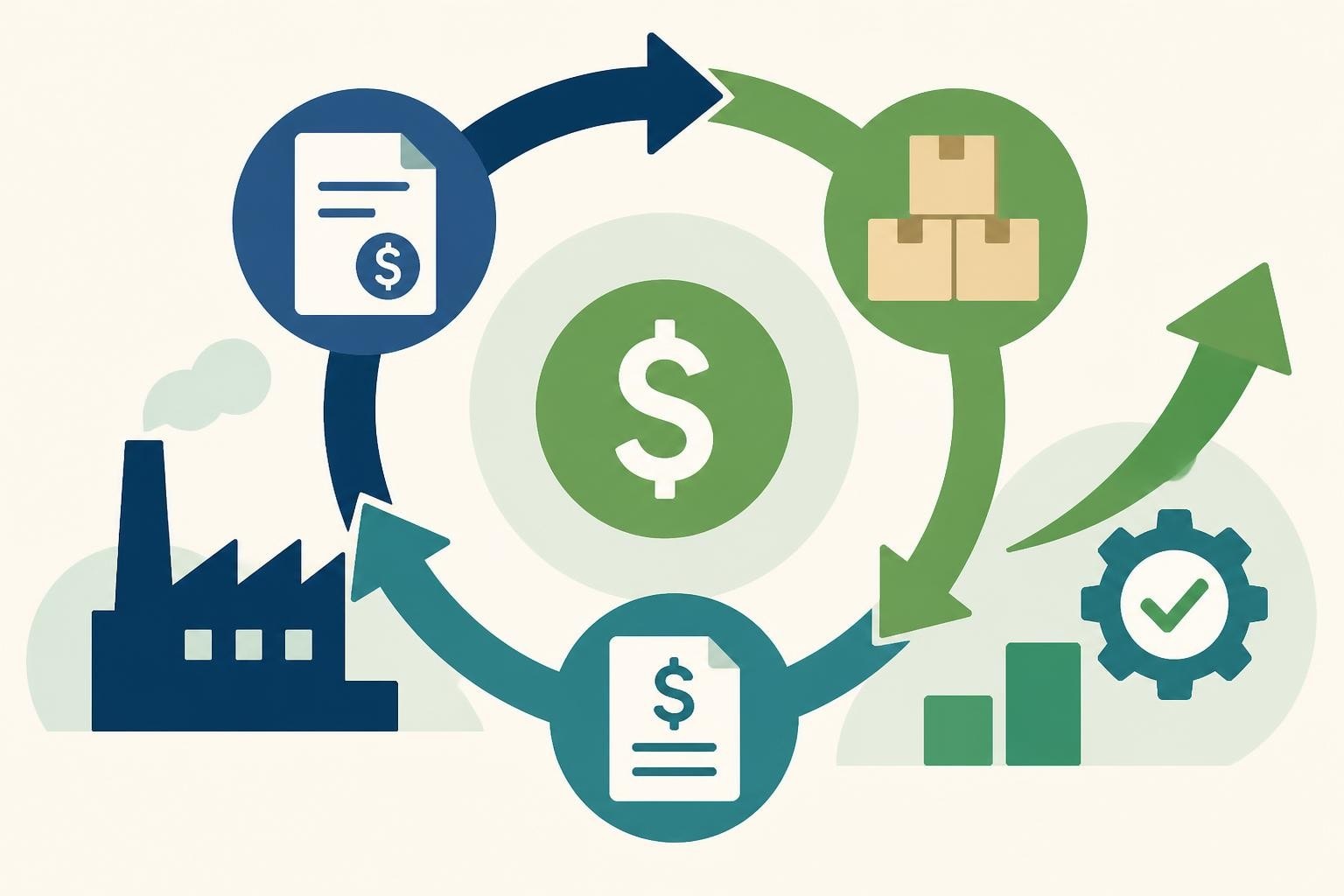
Managing liquidity remains one of the most critical challenges facing businesses across all sectors. The relationship between working capital and operational efficiency determines whether companies can meet short-term obligations, invest in growth opportunities, and weather economic uncertainty. Understanding this dynamic becomes especially important in capital-intensive industries where cash flow constraints can quickly escalate into existential threats. For finance professionals and executives, mastering the interplay between current assets and current liabilities isn't just good practice-it's essential for survival and competitive advantage.
Understanding the Working Capital Framework
Working capital and cash management form the foundation of financial health. At its core, working capital represents the difference between current assets (cash, accounts receivable, inventory) and current liabilities (accounts payable, short-term debt, accrued expenses). This metric reveals whether a business has sufficient liquid resources to fund daily operations without relying on external financing.
The Cash Conversion Cycle
The cash conversion cycle (CCC) measures how quickly a company converts invested cash back into cash through sales. This critical metric comprises three components:
- Days Inventory Outstanding (DIO): Time inventory sits before sale
- Days Sales Outstanding (DSO): Time to collect payment after sale
- Days Payable Outstanding (DPO): Time taken to pay suppliers
A shorter CCC generally indicates superior operational efficiency. Companies that collect receivables quickly, turn inventory rapidly, and strategically extend payables maintain stronger liquidity positions. Research on manufacturing firms demonstrates how the cash conversion cycle directly impacts profitability and financial flexibility.

Key Performance Metrics
Tracking the right metrics enables proactive management rather than reactive crisis response. The current ratio (current assets divided by current liabilities) provides a snapshot of short-term liquidity. A ratio between 1.5 and 3.0 typically indicates healthy working capital and adequate cushion for operational needs.
The quick ratio, which excludes inventory from current assets, offers a more conservative view. This metric proves particularly valuable for businesses with slow-moving inventory or those facing market uncertainty. Understanding working capital management fundamentals helps finance teams establish appropriate benchmarks for their specific industry context.
Strategic Components of Working Capital Management
Working capital and liquidity optimization requires attention to multiple interconnected elements. Each component offers distinct opportunities for improvement while contributing to overall financial resilience.
Accounts Receivable Optimization
Accelerating cash collection directly strengthens working capital positions. Many businesses leave significant value on the table through lax credit policies and inefficient collection processes.
Effective strategies include:
- Implementing clear credit terms before extending credit
- Conducting thorough credit checks on new customers
- Offering early payment discounts (typically 2/10 net 30)
- Establishing automated invoicing and payment reminders
- Regularly reviewing aging reports and following up promptly
- Considering invoice factoring for immediate cash needs
Companies should establish specific DSO targets based on industry standards and customer profiles. B2B enterprises typically experience longer collection periods than B2C businesses, but even within sectors, significant variation exists between top performers and average companies.
Inventory Management Excellence
Working capital and inventory levels maintain an inverse relationship. Excess inventory ties up cash that could fund other operational needs or strategic investments. Conversely, insufficient inventory risks stockouts, lost sales, and damaged customer relationships.
Companies that reduce excess inventory often discover substantial working capital improvements. The case study of a global manufacturer demonstrates how systematic inventory optimization enhanced both cash flow and customer service simultaneously.
| Inventory Strategy | Working Capital Impact | Risk Consideration |
|---|---|---|
| Just-in-Time (JIT) | Minimizes holding costs | Supply chain disruption vulnerability |
| Safety Stock Buffer | Increases carrying costs | Protects against stockouts |
| ABC Analysis | Optimizes capital allocation | Requires ongoing monitoring |
| Vendor-Managed Inventory | Transfers holding burden | Reduces direct control |
Modern businesses leverage technology for demand forecasting, implementing sophisticated algorithms that balance inventory costs against service levels. For capital-intensive operations, even modest improvements in inventory turns can release substantial cash.
Accounts Payable Strategies
Strategic payables management represents the often-overlooked component of working capital and liquidity enhancement. Extending payment terms without damaging supplier relationships creates natural financing for operations.
Negotiating favorable terms requires understanding supplier economics and demonstrating reliability. Companies with strong payment histories can often secure 60- or 90-day terms, effectively using supplier capital to fund operations. However, this approach requires balancing cash retention against early payment discounts and supplier relationship health.
Industry-Specific Considerations
Working capital and operational demands vary significantly across sectors. Capital-intensive industries face unique challenges that require tailored approaches.
Mining and Natural Resources
Gold mining operations and other natural resource companies encounter extreme working capital pressures. Long production cycles, commodity price volatility, and substantial upfront capital requirements create unique liquidity challenges.
These businesses must maintain adequate working capital and reserves to fund operations during price downturns while avoiding excessive cash hoarding during favorable periods. Risk management through hedging, flexible credit facilities, and conservative budgeting becomes essential.
Construction and Project-Based Businesses
Construction companies face distinct working capital challenges related to project timing and milestone payments. A $50 million construction firm's experience illustrates how mismatched cash inflows and outflows can create severe liquidity pressure despite profitable operations.
Project-based businesses benefit from:
- Progress billing to align receipts with costs
- Retainage management to accelerate final payments
- Subcontractor payment coordination
- Bonding capacity optimization
- Project-specific working capital forecasting

Manufacturing Operations
Manufacturing enterprises balance raw material purchases, work-in-process inventory, finished goods, and customer payments across complex supply chains. Working capital management in manufacturing requires coordinating procurement, production scheduling, and sales forecasting.
Leading manufacturers distinguish themselves through superior cash conversion cycles. Research by The Hackett Group reveals substantial gaps between world-class performers and average companies, with top quartile firms maintaining significantly shorter cash conversion cycles.
Advanced Working Capital Strategies
Beyond fundamental management, sophisticated organizations implement advanced techniques to optimize working capital and competitive positioning.
Dynamic Discounting and Supply Chain Finance
Supply chain finance programs enable buyers to extend payment terms while allowing suppliers to receive early payment through third-party financing. This arrangement benefits both parties-buyers preserve working capital and liquidity while suppliers access affordable financing.
Dynamic discounting allows buyers to capture early payment discounts when excess cash is available, creating flexible working capital and return on idle cash. These programs require robust systems and clear communication but can generate substantial value.
Working Capital Forecasting
Predictive modeling transforms working capital and treasury management from reactive to proactive. Thirteen-week cash flow forecasts provide detailed visibility into near-term liquidity needs, enabling preemptive action rather than emergency responses.
Effective forecasting incorporates:
- Historical patterns and seasonal variations
- Customer payment behavior analysis
- Supplier term agreements
- Production schedules and material requirements
- Capital expenditure timing
- Debt service obligations
Scenario planning adds further sophistication, modeling best-case, base-case, and stress scenarios. This approach reveals potential pressure points and guides contingency planning.
Technology and Automation
Modern treasury management systems automate routine tasks while providing real-time visibility into working capital and cash positions. Electronic invoicing, automated payment processing, and integrated forecasting tools reduce manual effort and improve accuracy.
Startups and growing companies particularly benefit from early technology adoption, establishing scalable processes before complexity overwhelms manual systems.
Financing Working Capital Needs
Even well-managed businesses occasionally require external financing to bridge working capital and operational gaps. Understanding available options enables strategic capital structure decisions.
Revolving Credit Facilities
Asset-based lending secured by accounts receivable and inventory provides flexible working capital financing. These facilities expand and contract with business needs, offering cost-effective access to capital during growth periods or seasonal peaks.
Lenders typically advance 80-85% against eligible receivables and 50-60% against eligible inventory. Maintaining clean financial records, accurate aging reports, and organized collateral documentation ensures ready access when needed and favorable terms.
Trade Credit Optimization
Supplier financing represents the most accessible form of working capital and liquidity support. Businesses should systematically review payment terms across their supplier base, identifying opportunities for extension or early payment discounts.
| Financing Option | Cost | Flexibility | Requirements |
|---|---|---|---|
| Revolving Credit | Prime + 2-4% | High | Collateral, covenants |
| Trade Credit | Implicit (discount foregone) | Medium | Relationship, history |
| Invoice Factoring | 1-5% per month | High | Quality receivables |
| Supply Chain Finance | Below buyer's cost | Medium | Program participation |
Working Capital Lines and Term Loans
Traditional bank financing provides straightforward working capital and expansion funding. Term loans suit permanent working capital needs in growing businesses, while lines of credit address temporary or seasonal requirements.
Lender readiness-maintaining current financial statements, clean books, and organized documentation-significantly improves approval odds and pricing. Many businesses benefit from advisory support when structuring facilities or navigating lender relationships, particularly during transitions or growth phases.

Building Financial Resilience Through Working Capital Excellence
Working capital and risk management intersect when companies build buffers against uncertainty. The 2020 pandemic, 2023 banking crisis, and ongoing economic volatility demonstrate how quickly liquidity can evaporate.
Stress Testing and Scenario Planning
Sophisticated organizations model working capital and cash flow under various stress scenarios. What happens if your largest customer delays payment 60 days? If commodity prices spike 30%? If access to credit lines becomes restricted?
These exercises reveal vulnerabilities and inform contingency planning. Companies can pre-negotiate backup facilities, establish supplier alternatives, or maintain strategic cash reserves based on identified risks.
Governance and Control Frameworks
Working capital and governance excellence requires clear policies, defined authority levels, and systematic monitoring. Treasury policies should specify:
- Minimum cash balance requirements
- Credit approval processes and limits
- Payment prioritization during stress
- Acceptable financing sources and terms
- Risk management parameters and hedging policies
Regular review by senior management and board oversight ensures policies evolve with business needs and market conditions. Strategic considerations for competitive advantage include working capital governance as a critical element for 2025 and beyond.
Organizational Alignment
Working capital and operational decisions connect across departments. Sales teams influence receivables through credit terms, operations impact inventory through production decisions, and procurement affects payables through supplier selection and negotiation.
Cross-functional collaboration ensures working capital optimization doesn't create unintended consequences. Regular communication between finance, operations, sales, and procurement aligns incentives and prevents siloed decision-making that undermines overall performance.
Measuring and Monitoring Performance
Sustained working capital and performance excellence requires systematic measurement and continuous improvement. Establishing dashboards with key metrics enables trend identification and proactive management.
Key Performance Indicators
Beyond the cash conversion cycle and standard ratios, leading companies track:
- Net Working Capital to Sales Ratio: Indicates capital efficiency
- Working Capital Turnover: Measures revenue generated per dollar of working capital
- Cash Conversion Efficiency: Percentage of EBITDA converted to operating cash flow
- Liquidity Runway: Months of operations fundable with current cash and facilities
Benchmarking against industry peers and historical performance reveals strengths and improvement opportunities. Comprehensive working capital management strategies provide frameworks for establishing appropriate targets and tracking progress.
Continuous Improvement Processes
Working capital and operational excellence initiatives should follow structured improvement methodologies. Quarterly reviews identifying specific targets-reduce DSO by 5 days, increase inventory turns by 0.3x, extend DPO by 3 days-create accountability and momentum.
Strategies that improve cash flow efficiency demonstrate how systematic working capital management enhances free cash flow conversion, enabling greater reinvestment and shareholder returns.
Celebrating successes and sharing best practices across the organization reinforces the importance of working capital discipline while building institutional capability. Working capital and culture become intertwined as financial awareness permeates operational decision-making at all levels.
Mastering the relationship between working capital and operational performance separates financially resilient organizations from those perpetually fighting liquidity crises. The strategies outlined here-from optimizing the cash conversion cycle to implementing sophisticated forecasting and governance frameworks-provide a roadmap for enhanced financial control and competitive advantage. Whether you're navigating seasonal demands, managing growth, or preparing for economic uncertainty, AurumCrest Advisory brings over 30 years of practical experience helping businesses strengthen liquidity positions, achieve lender readiness, and build sustainable financial resilience through strategic working capital management.