
The fundamental relationship between work and capital has shaped economic systems for centuries, yet today's finance leaders face unprecedented complexity in managing this balance. As businesses navigate technological disruption, changing workforce dynamics, and evolving capital markets, understanding how labor inputs and financial resources interact becomes critical for sustainable growth. For finance advisory professionals and corporate decision-makers, the strategic allocation of both work and capital determines competitive advantage, operational resilience, and long-term value creation in ways that demand careful analysis and planning.
The Economic Foundation of Work and Capital
The interaction between work and capital forms the bedrock of production economics. Capital in economics encompasses multiple forms, including physical assets, financial resources, and increasingly, intellectual property. Work represents the human effort, skills, and time invested in transforming these capital resources into productive outputs.
Traditional economic models treated work and capital as distinct factors of production, each contributing independently to output. However, modern research reveals a more nuanced reality where tasks, technology, and labor demand intersect in complex patterns. The substitutability and complementarity between these factors shift based on technology adoption, industry structure, and organizational capabilities.
Capital Utilization and Labor Productivity
Organizations must optimize how work and capital combine to generate value. Capital utilization rates directly impact the returns on invested resources, while labor productivity determines workforce efficiency. The relationship between these metrics reveals crucial insights about operational effectiveness.
Key considerations for finance leaders include:
- Physical capital requires ongoing maintenance and strategic replacement cycles
- Human capital development through training enhances overall productivity
- Working capital management affects both employment capacity and operational flexibility
- Technology investments can amplify or replace labor depending on implementation strategy

Financial resilience depends on maintaining appropriate ratios between invested capital and labor costs. Companies with excessive capital intensity may struggle with fixed cost burdens, while those over-reliant on labor face scalability challenges. The optimal balance varies by industry, growth stage, and competitive positioning.
Strategic Capital Allocation in Labor-Intensive Industries
Industries with significant labor components face unique challenges in balancing work and capital. The gold mining sector, for instance, requires substantial upfront capital investment in equipment and infrastructure while maintaining large workforces for extraction and processing operations.
| Industry Characteristic | Capital Implications | Labor Implications |
|---|---|---|
| High fixed costs | Large initial investment required | Workforce size less flexible in short term |
| Cyclical demand | Capital must support peak and trough periods | Training investment at risk during downturns |
| Regulatory compliance | Ongoing capital expenditure for safety and environmental standards | Specialized labor commands premium wages |
| Geographic constraints | Capital deployed in remote locations | Labor recruitment and retention challenges |
Research on capital utilization and accumulation demonstrates that firms constantly navigate tradeoffs between investing in new capacity and maximizing returns from existing assets. This balance becomes even more complex when considering workforce development as a form of capital investment.
Workforce as Capital Investment
Progressive finance leaders recognize that investments in work capabilities generate returns similar to physical capital. Training programs, succession planning, and organizational development require upfront expenditure but create lasting competitive advantages.
The analogy extends to measurement and reporting. Just as capital assets depreciate, workforce skills can become obsolete without continuous development. Conversely, well-designed career progression systems appreciate in value as institutional knowledge compounds.
Strategic workforce investment areas include:
- Technical skills training aligned with capital equipment upgrades
- Leadership development to improve capital allocation decisions
- Cross-functional capabilities that enhance operational flexibility
- Retention programs protecting institutional knowledge assets
- Performance management systems optimizing labor productivity
Modern Disruptions to Traditional Work and Capital Models
Technological advancement fundamentally alters how work and capital interact. Automation, artificial intelligence, and digital platforms create new possibilities for capital to substitute for or enhance labor productivity. Emerging research on Artificial General Intelligence suggests even more dramatic transformations may lie ahead.
These shifts require finance advisory professionals to reconsider traditional assumptions. Capital investments in technology may eliminate certain work categories while creating demand for new skills. The net employment effect depends on factors including implementation speed, workforce adaptability, and market growth rates.
Digital Transformation and Capital Requirements
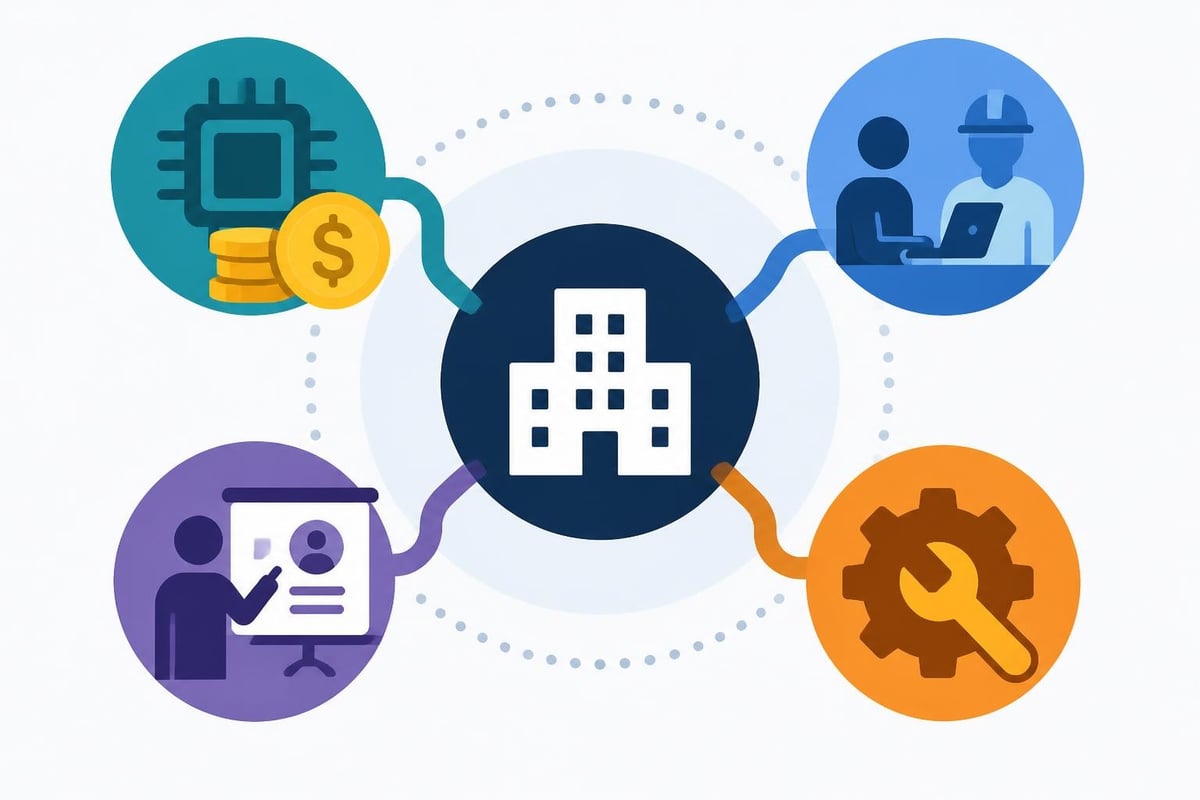
Digital transformation initiatives represent a particular category where work and capital intersect intensely. Software systems require significant capital investment but also demand skilled labor for implementation, customization, and ongoing optimization.
Organizations frequently underestimate the labor component of technology projects, focusing primarily on licensing costs and hardware requirements. Successful digital initiatives require balanced investment in both capital infrastructure and workforce capabilities.
Financial modeling for technology investments must account for:
- Initial capital expenditure on software, hardware, and infrastructure
- Implementation labor costs including internal staff time and consulting fees
- Training investments to build workforce competency
- Ongoing maintenance requiring both capital (licensing) and labor (support staff)
- Opportunity costs of work redirected from other value-creating activities
Risk Management Across Work and Capital Dimensions
Enterprise risk management must address vulnerabilities in both work and capital domains. Concentration risk affects organizations over-dependent on specific capital assets or key personnel. Liquidity risk emerges when capital is locked in illiquid investments while labor costs remain fixed obligations.
For companies in capital-intensive sectors like gold production and processing, managing the interplay between work and capital becomes central to financial resilience. AurumCrest Advisory works with clients to develop integrated risk frameworks addressing both workforce and capital vulnerabilities.
| Risk Category | Work-Related Manifestation | Capital-Related Manifestation | Mitigation Strategy |
|---|---|---|---|
| Liquidity | Fixed payroll obligations | Illiquid asset investments | Maintain working capital reserves |
| Operational | Key person dependency | Single asset concentration | Cross-training and diversification |
| Market | Wage inflation pressure | Asset value volatility | Long-term contracts and hedging |
| Regulatory | Labor law compliance costs | Capital requirement changes | Proactive governance frameworks |
The historical analysis of labor and capital dynamics reveals recurring patterns where economic pressures create tension between workforce investment and capital returns. Modern governance structures must balance stakeholder interests across both dimensions.
Lender Perspectives on Work and Capital
Financial institutions evaluating credit applications examine both workforce quality and capital structure carefully. Lenders recognize that sustainable businesses maintain healthy relationships between work and capital, avoiding over-leverage in either dimension.
Strong workforce capabilities signal operational competence and execution capacity. Well-maintained capital assets demonstrate financial discipline and long-term thinking. Companies presenting credible plans for balancing investments in both areas improve their lender readiness and access to favorable financing terms.
Lenders assess:
- Debt-to-equity ratios reflecting capital structure
- Payroll as percentage of revenue indicating labor efficiency
- Capital expenditure plans and their labor implications
- Workforce turnover rates suggesting organizational stability
- Training investment levels demonstrating commitment to capabilities
Measuring Return on Work and Capital Investments
Financial metrics traditionally focus on capital returns, but comprehensive performance measurement requires evaluating work productivity alongside capital efficiency. Return on invested capital (ROIC) provides one lens, while revenue per employee offers another perspective on the work and capital balance.
Advanced organizations develop integrated dashboards tracking both dimensions. These metrics inform resource allocation decisions and highlight areas where rebalancing might improve overall performance.
Composite Performance Indicators
The most sophisticated measurement approaches combine work and capital metrics into composite indicators reflecting total factor productivity. These measurements acknowledge that value creation emerges from the interaction between labor inputs and capital resources rather than either factor in isolation.
Useful composite metrics include:
- Economic Value Added (EVA): Accounts for total capital costs including both financial capital and human resources
- Total Factor Productivity: Measures output relative to combined work and capital inputs
- Operating Leverage: Reveals how fixed capital investments and variable labor costs affect profitability at different revenue levels
- Cash Conversion Efficiency: Tracks how effectively work and capital convert to cash flow
- Return on Total Assets per Employee: Combines capital asset productivity with workforce efficiency

These integrated approaches help finance leaders identify whether performance gaps stem from capital constraints, workforce limitations, or suboptimal combinations of both factors.
Organizational Structure and Resource Allocation
How companies organize themselves influences the effectiveness of work and capital deployment. Centralized decision-making may optimize capital allocation across business units but can limit local responsiveness in workforce management. Decentralized structures empower operational leaders to balance work and capital at the front line but may sacrifice scale economies.
The organizational design question intersects directly with work and capital efficiency. Matrix structures attempt to balance functional expertise in capital planning with business unit accountability for results. However, unclear accountability often leads to suboptimal resource allocation in both dimensions.
Governance Frameworks for Balanced Investment
Effective governance establishes clear processes for evaluating investment proposals across both work and capital categories. Capital budgeting committees should explicitly consider labor implications of asset investments, while workforce planning must account for capital constraints and opportunities.
Best-practice governance frameworks include:
- Integrated planning cycles aligning workforce and capital budgets
- Cross-functional review of major investment proposals
- Scenario analysis examining different work and capital combinations
- Post-implementation reviews assessing actual returns versus projections
- Continuous improvement processes refining allocation methodologies
Companies serving as stewards of both workforce potential and capital resources must develop governance structures reflecting this dual responsibility. Understanding the power of collective investment through mechanisms like employee ownership can align workforce and capital interests more effectively.
Industry-Specific Applications in Finance and Mining
The gold industry exemplifies sectors where work and capital interact intensely. Mining operations require massive capital investments in exploration, development, and processing infrastructure. Simultaneously, these operations depend on skilled workforces spanning geologists, engineers, equipment operators, and processing specialists.
Finance advisory services supporting this sector must understand both dimensions thoroughly. Capital structure decisions affect debt capacity and financing costs. Workforce capability assessments inform operational risk evaluations. The interplay between these factors determines project viability and ongoing enterprise value.
Practical Advisory Considerations
Advisory professionals helping clients optimize work and capital allocation should consider:
- Industry benchmarks comparing labor intensity and capital efficiency across peer companies
- Technology adoption curves indicating where automation may shift work-capital balances
- Regulatory trends affecting either labor costs or capital requirements
- Market cycles influencing optimal timing for workforce expansion or capital investment
- Liquidity constraints limiting flexibility to invest in either dimension
The advisory relationship adds value by bringing external perspective to internal resource allocation debates. Experienced advisors recognize patterns across multiple client situations, identifying optimization opportunities that internal teams may overlook.
Future Trajectories in Work and Capital Evolution
The relationship between work and capital continues evolving as technology, demographics, and economic structures shift. Aging populations in developed economies may constrain labor supply while increasing capital availability through accumulated savings. Emerging technologies may enable capital to substitute for labor across broader task categories.
Theoretical frameworks examining monetary effects on capital formation suggest that macroeconomic conditions influence microeconomic decisions about work and capital investment. Finance leaders must monitor these broader trends while managing tactical resource allocation decisions.
Climate transition represents another major force reshaping work and capital dynamics. Green technology investments require new capital deployment while creating demand for specialized labor skills. Companies navigating this transition face complex decisions about retraining existing workforces versus recruiting new capabilities, all while managing capital constraints and competing investment priorities.
The sophistication required to manage these intersecting factors increases continuously. Finance advisory professionals must integrate diverse knowledge spanning labor economics, capital markets, technology trends, and industry-specific operational realities to provide meaningful guidance.
Successfully managing the balance between work and capital requires integrated thinking that bridges traditional functional silos in finance, operations, and human resources. Organizations that develop sophisticated frameworks for optimizing both dimensions create sustainable competitive advantages through superior resource allocation. Whether you're navigating capital structure decisions, workforce investments, or the complex interplay between these critical resources, AurumCrest Advisory brings over three decades of experience helping clients strengthen financial resilience through practical, strategic guidance tailored to your specific industry challenges and opportunities.