
Every financial decision carries inherent uncertainty, requiring organizations to carefully weigh potential outcomes against probability and impact. In corporate finance and specialized industries like gold and commodities, the ability to make informed risk decisions separates thriving organizations from those that struggle during economic turbulence. A risk decision involves systematically evaluating uncertain scenarios, quantifying potential losses or gains, and committing resources based on evidence rather than intuition. For finance executives and advisory professionals, mastering this discipline has become essential to maintaining liquidity, satisfying lender requirements, and building organizational resilience in an increasingly volatile market environment.
Understanding the Risk Decision Framework
The foundation of any effective risk decision begins with a structured approach to identifying, analyzing, and responding to uncertainty. Organizations that excel in this area don't rely on gut feelings or historical patterns alone. They implement systematic frameworks that bring consistency and rigor to how they evaluate threats and opportunities.
Risk management frameworks provide the architectural blueprint for decision-making under uncertainty. These frameworks, including NIST RMF, ISO 31000, and COSO ERM, share common elements while addressing different organizational needs and regulatory environments. Each framework emphasizes the importance of context, criteria, and consequence evaluation before committing to a course of action.
Core Components of Risk Decision Architecture
Building an effective risk decision process requires several interconnected elements working in harmony:
- Risk identification systems that capture both internal and external threats
- Quantitative assessment methodologies using probability distributions and impact modeling
- Stakeholder engagement protocols ensuring diverse perspectives inform the decision
- Resource allocation mechanisms that match capital deployment to risk-adjusted returns
- Monitoring and feedback loops that enable course correction as conditions change
The integration of these components creates a decision-making environment where uncertainty becomes manageable rather than paralyzing. Organizations gain the ability to move forward confidently even when complete information remains unavailable.

Quantifying Uncertainty in Financial Contexts
Numbers bring discipline to risk decisions that qualitative assessments alone cannot provide. In corporate finance advisory, quantification transforms vague concerns about market conditions or counterparty reliability into measurable metrics that support rational choice.
Probability Assessment Techniques
Accurate probability estimation forms the cornerstone of sound risk decisions. Finance professionals employ multiple approaches to gauge likelihood:
- Historical frequency analysis examining how often similar events occurred in the past
- Expert elicitation gathering structured judgments from specialists with relevant experience
- Monte Carlo simulation running thousands of scenarios to map the distribution of possible outcomes
- Bayesian updating adjusting initial probability estimates as new evidence emerges
Each technique offers distinct advantages depending on data availability, time constraints, and the nature of the risk under consideration. The most robust risk decision processes combine multiple methods to triangulate probability estimates and reduce estimation error.
| Assessment Method | Best Use Case | Data Requirements | Typical Timeframe |
|---|---|---|---|
| Historical Analysis | Recurring operational risks | Extensive historical records | 2-4 weeks |
| Expert Elicitation | Novel or rare events | Access to domain specialists | 1-2 weeks |
| Monte Carlo Simulation | Complex multi-variable scenarios | Probability distributions for inputs | 3-5 weeks |
| Bayesian Methods | Evolving situations | Prior estimates plus new data | Ongoing |
Impact Valuation and Consequence Modeling
Understanding probability without grasping consequence leaves the risk decision incomplete. Impact assessment requires translating potential events into financial terms that enable comparison across different risk categories.
For organizations in the gold industry or commodity-dependent sectors, impact modeling must account for price volatility, supply chain disruptions, regulatory changes, and geopolitical instability. Each factor contributes to the total exposure profile. A comprehensive risk decision incorporates correlation between risk factors, recognizing that multiple threats may materialize simultaneously during stress periods.
Expected value calculations provide a starting point by multiplying probability by impact, but sophisticated risk decisions go further. They examine tail risks, stress test assumptions, and evaluate second-order effects that cascade through the organization. This depth of analysis proves particularly valuable when implementing risk-based decision-making processes across diverse business units.
Strategic Risk Decision Making in Finance Advisory
Advisory relationships depend on the quality of recommendations provided during critical junctures. When clients face major capital allocation choices, refinancing decisions, or strategic pivots, the risk decision framework advisors employ directly impacts outcomes.
Aligning Risk Appetite with Business Objectives
Every organization possesses a unique risk appetite shaped by its capital structure, competitive position, stakeholder expectations, and strategic goals. An effective risk decision respects these boundaries while pushing for optimal outcomes within acceptable limits.
Finance advisors must first establish clear risk tolerance thresholds across multiple dimensions:
- Liquidity risk determining minimum cash reserves and working capital buffers
- Credit risk setting counterparty exposure limits and concentration thresholds
- Market risk defining acceptable volatility in commodity prices or currency exposure
- Operational risk establishing tolerances for process failures or system downtime
With these parameters defined, subsequent risk decisions can be evaluated consistently against established criteria. This alignment ensures that individual choices aggregate into a coherent risk profile rather than creating unintended concentrations or gaps in protection.

Lender Readiness and Risk Communication
Organizations seeking to maintain or improve their borrowing capacity must demonstrate disciplined risk decision processes to financial institutions. Lenders increasingly scrutinize not just current financial metrics but the quality of risk governance and decision-making frameworks.
A well-documented risk decision trail provides evidence of:
- Systematic identification of material threats and opportunities
- Rigorous analysis using appropriate quantitative and qualitative methods
- Clear rationale for chosen courses of action
- Defined accountability and escalation protocols
- Regular monitoring and adjustment mechanisms
This transparency builds lender confidence and often translates into improved pricing, higher credit limits, or more flexible covenant structures. The National Research Council's research on risk and decision-making emphasizes how structured approaches to uncertainty enhance stakeholder trust and support better outcomes across diverse domains.
Practical Implementation Challenges
Theory and practice diverge significantly when organizations attempt to embed robust risk decision processes into daily operations. Several obstacles consistently emerge across industries and organizational sizes.
Data Quality and Availability Issues
Sound risk decisions require reliable data, yet many organizations struggle with incomplete records, inconsistent definitions, or siloed information systems. Historical loss data may not exist for emerging risks. External market data may be expensive or difficult to interpret without specialized expertise.
Addressing data gaps requires a pragmatic approach:
- Start with available information rather than waiting for perfect datasets
- Document assumptions explicitly to enable sensitivity testing
- Invest incrementally in data infrastructure as risk decision value becomes apparent
- Supplement internal data with industry benchmarks and expert judgment
- Build feedback mechanisms that improve data quality over time
Cognitive Biases and Organizational Culture
Human judgment influences every risk decision, introducing systematic biases that can distort outcomes. Overconfidence leads to underestimating probabilities. Anchoring creates excessive attachment to initial estimates. Availability bias overweights recent events.
Creating a culture that supports objective risk decisions requires active management of these psychological tendencies. Organizations benefit from structured decision protocols, diverse review teams, and pre-commitment devices that prevent rationalization after outcomes become known. Risk-based decision systems incorporating formal frameworks help counteract individual biases through systematic processes.
Advanced Techniques for Complex Scenarios
As organizations mature in their risk decision capabilities, they can deploy more sophisticated analytical tools that capture nuances simpler methods miss.
Scenario Analysis and Stress Testing
Rather than relying on single-point probability estimates, advanced risk decisions explore multiple plausible futures. Scenario analysis develops coherent narratives about how conditions might evolve, then evaluates strategic options against each pathway.
For gold industry participants, relevant scenarios might include:
- Inflationary surge driving gold prices to multi-year highs while increasing production costs
- Regulatory tightening imposing new environmental or labor requirements across key jurisdictions
- Technology disruption enabling new extraction methods or synthetic alternatives
- Geopolitical instability affecting supply chains and market access
Stress testing pushes scenarios to extremes, examining whether the organization can survive worst-case combinations of adverse events. This approach reveals hidden vulnerabilities and informs contingency planning that strengthens overall resilience.
| Scenario Type | Key Variables | Decision Impact | Planning Horizon |
|---|---|---|---|
| Base Case | Current trends continue | Normal operations | 1-2 years |
| Optimistic | Favorable market + operations | Growth investment | 2-3 years |
| Pessimistic | Adverse market + disruptions | Defensive positioning | 1-2 years |
| Extreme Stress | Multiple concurrent shocks | Survival threshold | 6-12 months |
Decision Trees and Real Options Analysis
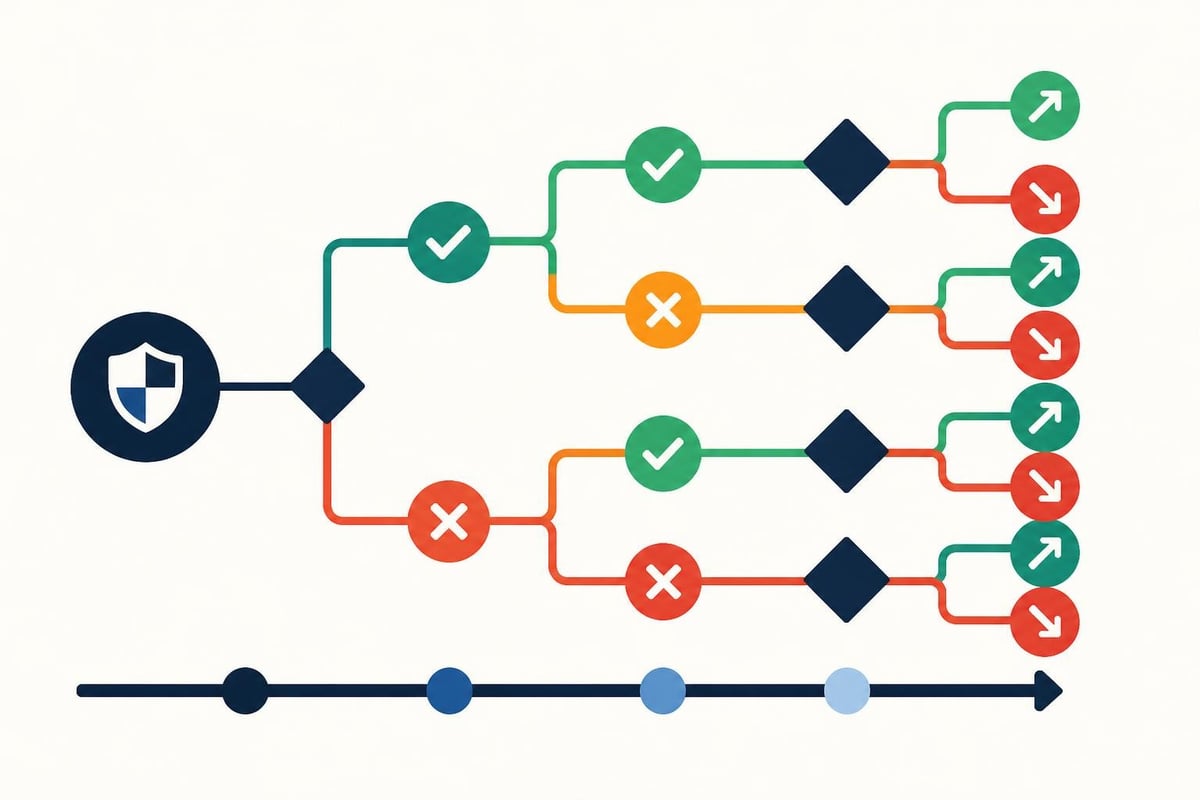
Some risk decisions involve sequential choices where later actions depend on how earlier uncertainties resolve. Decision trees map these pathways, calculating expected values at each node to identify optimal initial moves.
Real options analysis extends this thinking by valuing flexibility explicitly. The ability to expand, contract, delay, or abandon a project has economic worth that traditional net present value calculations ignore. A risk decision incorporating option value may justify maintaining capacity or continuing development work that appears marginally attractive under conventional analysis.
Governance and Accountability Structures
Effective risk decisions require clear ownership and appropriate escalation protocols. Ambiguity about who decides, using what criteria, creates confusion and delays when swift action is needed.
Risk Decision Authority Levels
Organizations benefit from tiered decision rights that balance speed with appropriate oversight:
- Operational level managing routine risks within established tolerance bands
- Tactical level addressing larger exposures or risks outside normal parameters
- Strategic level determining risk appetite, major capital commitments, and enterprise-wide policies
- Board oversight ensuring coherent risk strategy and adequate resources for risk management
Each level requires appropriate analytical support, reporting templates, and time horizons. A risk decision about daily treasury operations demands different rigor than one reshaping the business model, yet both need systematic approaches suited to their scope and impact.
Documentation and Learning Systems
Every significant risk decision should generate a record capturing the context, analysis, alternatives considered, rationale for the choice made, and expected outcomes. This documentation serves multiple purposes beyond immediate accountability.
When organizations review risk decisions after outcomes become known, they gain invaluable insights into the quality of their processes. Were probability estimates accurate? Did impact assessments capture actual consequences? Which analytical techniques proved most useful? This learning loop transforms risk decision-making from an art into a continuously improving discipline.
Integration with Strategic Planning
Risk decisions shouldn't exist in isolation from broader strategic processes. The most effective organizations embed risk thinking throughout strategy development, capital budgeting, performance management, and organizational design.
Capital Allocation and Portfolio Optimization
Every investment represents a risk decision that commits scarce resources to uncertain outcomes. Portfolio optimization techniques help organizations balance risk and return across multiple initiatives, identifying combinations that achieve strategic objectives within acceptable risk levels.
For finance advisory clients, this integration proves particularly valuable during periods of constrained liquidity or when preparing for refinancing discussions. Demonstrating that capital allocation reflects rigorous risk decision processes strengthens the credibility of business plans and financial projections. The risk-informed approach to decision-making enables consistent resource allocation across diverse opportunities.
Performance Metrics and Incentive Alignment
Measurement systems influence behavior powerfully. When performance metrics ignore risk, they incentivize excessive risk-taking. When metrics punish all losses equally, they discourage appropriate risk-taking that creates value.
Risk-adjusted performance measures provide better alignment:
- Return on risk-adjusted capital (RORAC) incorporating economic capital requirements
- Sharpe ratios comparing returns to volatility for investment portfolios
- Value at risk (VaR) metrics constraining downside exposure
- Risk-adjusted net present value for project evaluation
These metrics ensure that risk decisions balance upside potential with downside protection, supporting sustainable value creation rather than short-term gains that jeopardize long-term viability.
Technology Enablement and Digital Transformation
Digital tools increasingly support sophisticated risk decision processes that were impractical when relying solely on manual analysis. Organizations that leverage technology effectively gain competitive advantages in speed, consistency, and analytical depth.
Data Analytics and Visualization Platforms
Modern analytics platforms transform raw data into actionable insights through interactive dashboards, automated reporting, and real-time monitoring. Risk managers can track key indicators continuously rather than waiting for monthly reports, enabling faster responses when conditions deteriorate.
Machine learning algorithms identify patterns humans might miss, flagging anomalies that warrant investigation. Natural language processing extracts risk signals from unstructured sources like contracts, regulatory filings, or news feeds. These capabilities enhance the information foundation supporting each risk decision.
Integration with Enterprise Systems
Standalone risk management tools create inefficiencies and data synchronization challenges. Leading organizations integrate risk decision support directly into enterprise resource planning, treasury management, and financial reporting systems.
This integration ensures that risk considerations appear automatically when relevant decisions arise. A purchasing manager sees counterparty risk scores when selecting suppliers. A treasury analyst receives liquidity stress test results when evaluating short-term investment options. Finance leaders access consolidated risk dashboards alongside financial statements during strategic reviews.
The typical framework for the decision-making process emphasizes understanding requirements and objectives, which becomes more achievable when technology connects risk intelligence to operational workflows seamlessly.
Regulatory Compliance and Industry Standards
External requirements increasingly mandate specific risk decision processes, particularly in regulated industries and for organizations above certain size thresholds. Compliance adds complexity but also provides structure that benefits even firms without formal obligations.
Adapting Standard Frameworks to Specific Contexts
While frameworks like ISO 31000 or COSO ERM provide valuable templates, mechanical application without customization rarely delivers optimal results. Each organization must adapt standard approaches to its unique circumstances, risk profile, and strategic priorities.
For gold industry participants, this adaptation might emphasize commodity price risk, geopolitical exposure in mining jurisdictions, environmental liability management, and supply chain resilience. Generic frameworks provide the skeleton; industry expertise supplies the vital organs and connective tissue that make risk decisions relevant and actionable.
Documentation Requirements and Audit Trails
Regulators and external auditors increasingly scrutinize risk decision processes, requiring evidence that appropriate considerations informed material choices. Organizations must balance thoroughness with efficiency, creating documentation that satisfies oversight needs without paralyzing decision-making.
Best practices include standardized templates for different decision types, clear sign-off protocols, and centralized repositories where historical risk decisions can be retrieved and reviewed. This infrastructure supports both compliance and organizational learning, creating permanent value beyond satisfying external requirements.
Mastering the risk decision discipline enables organizations to navigate uncertainty with confidence, allocating resources effectively while maintaining appropriate safeguards against adverse outcomes. Whether evaluating capital investments, managing liquidity during market stress, or preparing for lender discussions, systematic approaches to risk transform decision quality and build sustainable competitive advantages. AurumCrest Advisory brings over 30 years of experience helping organizations strengthen their risk decision frameworks, enhance financial resilience, and achieve their strategic objectives through practical, proven solutions tailored to the unique challenges of corporate finance and the gold industry.