
Marketplace risk represents a critical concern for corporations operating in increasingly interconnected digital and financial ecosystems. As businesses expand their operations through third-party platforms, digital marketplaces, and alternative lending channels, understanding and managing the multifaceted nature of marketplace risk becomes essential for financial resilience. This comprehensive examination explores how marketplace risk affects corporate finance decisions, governance structures, and strategic planning in 2026, providing finance leaders with actionable frameworks for risk identification and mitigation.
The Foundation of Marketplace Risk
Marketplace risk encompasses the potential for financial loss, reputational damage, or operational disruption arising from participation in marketplace environments. These risks extend beyond traditional market volatility to include platform-specific vulnerabilities, counterparty exposure, and regulatory compliance challenges.
Understanding marketplace risk requires recognizing its multidimensional nature. The concept affects businesses operating in physical marketplaces, digital platforms, financial marketplaces, and hybrid models. Each environment presents unique risk profiles that demand tailored mitigation strategies.
Key Components of Marketplace Exposure
The anatomy of marketplace risk includes several interconnected elements that finance professionals must evaluate:
- Platform dependency risk: Reliance on third-party infrastructure for revenue generation
- Counterparty concentration: Exposure to default or non-performance by marketplace participants
- Liquidity constraints: Potential inability to exit positions or convert assets quickly
- Regulatory uncertainty: Evolving compliance requirements across jurisdictions
- Technology vulnerabilities: System failures, cybersecurity threats, and data breaches
Financial advisors recognize that marketplace risk intensifies during periods of economic volatility. The 2026 business environment, characterized by rapid technological advancement and geopolitical uncertainty, amplifies these concerns for corporate treasurers and CFOs.

Categories of Marketplace Risk in Corporate Finance
Different types of marketplace risk require distinct analytical frameworks and mitigation approaches. Finance teams must develop comprehensive risk taxonomies that address both macro-level and transaction-specific exposures.
Systemic and Economic Risks
Systemic marketplace risk refers to vulnerabilities that affect entire marketplace ecosystems rather than individual participants. These risks include:
- Market infrastructure failures that cascade across multiple platforms
- Regulatory changes that fundamentally alter marketplace economics
- Macroeconomic shocks that reduce overall marketplace liquidity
- Technology disruptions that render existing platforms obsolete
Economic marketplace risk manifests through price volatility, demand fluctuations, and capital availability constraints. Corporations utilizing marketplace lending, for instance, face interest rate risk and credit cycle exposure that traditional banking relationships might mitigate differently.
Competitive and Operational Dimensions
Competitive marketplace risk emerges when new entrants disrupt established platform dynamics or when dominant players implement unfavorable policy changes. This risk category particularly affects businesses that have concentrated their sales or procurement channels through limited marketplace relationships.
| Risk Category | Primary Impact | Mitigation Priority |
|---|---|---|
| Systemic Risk | Ecosystem-wide disruption | Diversification, contingency planning |
| Economic Risk | Cash flow volatility | Hedging, liquidity reserves |
| Competitive Risk | Market share erosion | Multi-channel strategy |
| Operational Risk | Process breakdown | Controls, redundancy |
Operational marketplace risk includes transaction processing failures, settlement delays, and platform service interruptions. These seemingly tactical issues can cascade into strategic concerns when they affect working capital management or customer commitments.
Third-Party Marketplace Vulnerabilities
Corporations increasingly leverage third-party marketplaces for revenue generation, procurement, and financing. However, risks associated with third-party marketplaces introduce governance challenges that traditional risk frameworks may inadequately address.
Control and Visibility Limitations
Third-party marketplace participation often requires surrendering elements of operational control. Pricing authority, customer relationship ownership, and brand presentation may shift to platform operators. For corporations accustomed to direct market engagement, this transition introduces unfamiliar risk exposures.
Critical control gaps include:
- Inability to set final pricing without platform override authority
- Limited access to customer data and transaction analytics
- Restricted communication channels with end buyers or suppliers
- Dependence on platform reputation and service quality
Finance leaders must quantify the value of surrendered control against marketplace access benefits. This calculation involves both immediate revenue implications and long-term strategic positioning considerations.
Reputational and Compliance Exposure
Marketplace risk extends to reputational dimensions when platform practices conflict with corporate values or quality standards. Unauthorized sellers, counterfeit products, or service quality inconsistencies on third-party platforms can damage brand equity that corporations have invested decades building.
Compliance exposure intensifies in regulated industries where marketplace transactions must meet specific documentation, licensing, or reporting requirements. Financial services firms face particularly acute challenges ensuring that marketplace activities align with anti-money laundering, know-your-customer, and fiduciary duty obligations.

Marketplace Lending and Credit Risk
The growth of marketplace lending platforms has created alternative financing channels for corporations seeking working capital or expansion funding. While marketplace lending offers speed and accessibility advantages over traditional banking, it introduces distinct risk considerations.
Underwriting and Credit Assessment
Marketplace lenders typically employ algorithmic underwriting models that differ fundamentally from relationship-based banking approaches. These automated systems may:
- Emphasize cash flow velocity over balance sheet strength
- Weight recent operating trends more heavily than historical performance
- Incorporate non-traditional data sources into credit decisions
- Apply standardized terms with limited negotiation flexibility
Corporations utilizing marketplace lending must understand how these underwriting differences affect their cost of capital and covenant requirements. The transparency benefits of standardized processes must be weighed against the flexibility that relationship banking sometimes provides during financial stress.
Liquidity and Refinancing Considerations
Marketplace risk in lending contexts includes potential inability to refinance expiring facilities if platform economics shift or lender appetite diminishes. Unlike traditional banks with relationship incentives to support ongoing customers, marketplace lenders often operate purely on transaction economics.
Key liquidity risk factors:
- Platform viability and continued investor participation
- Market condition sensitivity affecting lender risk tolerance
- Limited workout flexibility during financial difficulty
- Potential for rapid facility termination without relationship cushion
Financial advisors recommend that corporations maintain diversified funding sources rather than concentrating liquidity access through single marketplace platforms. This diversification principle applies equally to accounts receivable financing, inventory funding, and term loan facilities.
Governance Frameworks for Marketplace Risk
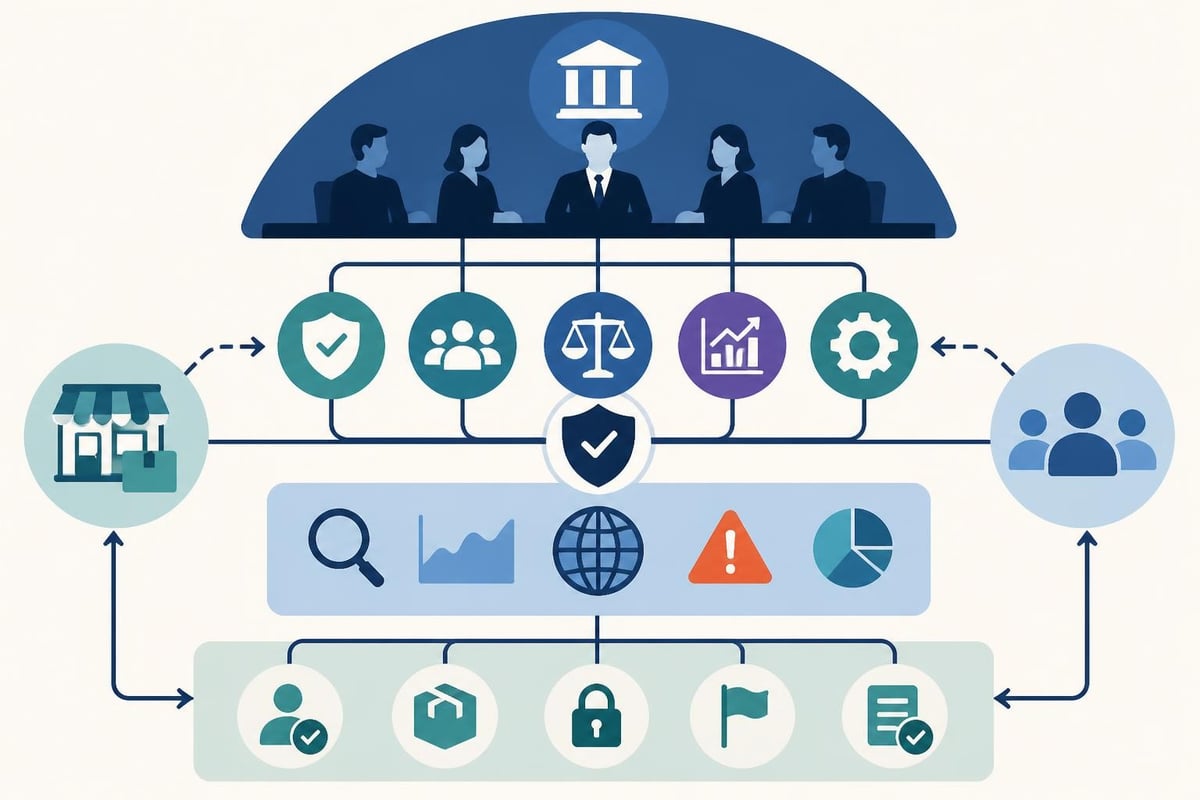
Effective marketplace risk management requires governance structures that span treasury, operations, legal, and technology functions. The interconnected nature of marketplace exposures demands cross-functional coordination beyond traditional risk silo approaches.
Board-Level Oversight Requirements
Marketplace risk warrants board attention when platform dependencies represent material revenue sources, critical supply chain elements, or significant financing relationships. Directors should understand:
- The concentration of business activity through marketplace channels
- Financial implications of platform policy changes or relationship termination
- Regulatory exposure specific to marketplace participation
- Technology dependencies and cybersecurity vulnerabilities
Risk committees should review marketplace exposures quarterly, with annual deep-dives into platform relationship health and strategic alternatives. This governance cadence balances oversight rigor with operational flexibility.
Risk Assessment and Monitoring Systems
Quantifying marketplace risk requires metrics that capture both financial and operational dimensions:
| Metric Category | Example Measures | Review Frequency |
|---|---|---|
| Concentration | Percentage of revenue via top 3 platforms | Monthly |
| Performance | Transaction success rates, settlement timing | Weekly |
| Financial | Platform-related DSO, working capital impact | Monthly |
| Compliance | Regulatory incident tracking, audit findings | Quarterly |
Modern treasury management systems increasingly incorporate marketplace transaction monitoring alongside traditional banking activity. This integration enables comprehensive liquidity forecasting that accounts for platform-specific settlement patterns and holds.
Strategic Mitigation Approaches
Corporations cannot eliminate marketplace risk entirely without forgoing marketplace benefits. Instead, sophisticated finance teams implement layered mitigation strategies that reduce exposure while preserving strategic optionality.
Diversification and Redundancy
The primary marketplace risk mitigation strategy involves diversifying platform relationships to avoid single points of failure. Companies should:
- Maintain active relationships with multiple marketplaces in each critical category
- Develop direct channel alternatives that can scale if marketplace access diminishes
- Test secondary platforms periodically to ensure operational readiness
- Negotiate contracts that preserve flexibility to reduce platform dependence
However, diversification introduces complexity costs through multiple integrations, relationship management overhead, and potential volume discount sacrifices. Finance leaders must optimize the diversification level based on specific risk tolerance and operational capability.
Contractual Protections and Relationship Management
Marketplace participation agreements often contain provisions that shift risk disproportionately toward corporate participants. Negotiating improved terms requires understanding platform economics and competitive dynamics.
Priority contractual elements include:
- Pricing authority and discount limitation clauses
- Data access and portability rights
- Service level guarantees with financial remedies
- Termination notice periods and transition assistance
- Liability caps and indemnification boundaries
Relationship management extends beyond contract terms to ongoing communication with platform representatives. Understanding platform strategic priorities, technology roadmaps, and policy development processes helps corporations anticipate changes before they create operational disruption.
Technology and Data Security Dimensions
Marketplace risk increasingly manifests through technology vulnerabilities and data security exposures. As corporations integrate marketplace platforms into core business processes, the potential impact of technology failures intensifies.
Integration Architecture and Dependencies
Application programming interface connections between corporate systems and marketplace platforms create bidirectional risk. System failures can prevent order processing, delay payments, or expose sensitive data. Finance teams must work with technology colleagues to ensure:
- Redundant connectivity pathways for critical marketplace integrations
- Real-time monitoring of integration health and transaction success rates
- Graceful degradation capabilities when marketplace systems experience issues
- Data synchronization protocols that prevent inventory or pricing discrepancies
The 2026 technology landscape features increasingly sophisticated integration platforms that simplify marketplace connectivity. However, these middleware solutions introduce additional dependency layers that require evaluation within overall marketplace risk frameworks.
Data Privacy and Regulatory Compliance
Marketplace transactions generate substantial data that corporations must manage consistent with privacy regulations. The intersection of marketplace risk and data governance includes:
- Customer data sharing agreements with marketplace platforms
- Compliance with regional privacy laws across marketplace jurisdictions
- Incident response protocols when platforms experience data breaches
- Data retention and deletion capabilities aligned with regulatory requirements
Finance professionals should coordinate with legal and compliance teams to ensure marketplace contracts adequately address data governance requirements. The potential financial penalties for privacy violations represent material marketplace risk that warrants explicit mitigation strategies.
Industry-Specific Marketplace Considerations
Marketplace risk manifests differently across industries based on regulatory frameworks, competitive dynamics, and operational characteristics. Finance advisors must tailor risk assessment approaches to industry-specific contexts.
Financial Services and Regulatory Scrutiny
Financial institutions face heightened marketplace risk due to regulatory obligations that extend to platform relationships. Banks utilizing fintech marketplaces for loan origination, payment processing, or investment services must ensure platform activities comply with banking regulations, consumer protection laws, and fiduciary standards.
Regulatory examinations increasingly scrutinize third-party marketplace relationships as extensions of institutional operations rather than arm's-length vendor arrangements. This heightened oversight requires enhanced due diligence, ongoing monitoring, and formal governance processes that traditional vendor management may not address.
Commodity and Physical Goods Marketplaces
Companies in commodity sectors or physical goods distribution encounter marketplace risk through pricing transparency, supply chain visibility, and quality control challenges. Gold industry participants, for example, face unique marketplace dynamics around:
- Price discovery mechanisms and basis risk between spot and marketplace pricing
- Authentication and quality verification in digital marketplace contexts
- Settlement timing and counterparty credit exposure
- Regulatory requirements for precious metal transactions across jurisdictions
These industry-specific considerations require customized risk frameworks that address sector-unique vulnerabilities while incorporating general marketplace risk management principles. AurumCrest Advisory helps clients in specialized industries develop tailored approaches that address both universal and sector-specific marketplace exposures.
Financial Modeling and Scenario Analysis
Quantifying marketplace risk requires financial models that capture both baseline exposures and stress scenarios. Treasury teams should develop analytical frameworks that assess potential impacts across multiple dimensions.
Baseline Risk Quantification
Establishing baseline marketplace risk exposure involves calculating metrics such as:
- Revenue at risk from top marketplace platform relationship termination
- Working capital impact from extended marketplace settlement cycles
- Cost of capital differential between marketplace and traditional financing
- Customer acquisition cost allocated to marketplace channel access
These baseline calculations provide context for evaluating whether marketplace risk levels align with overall corporate risk tolerance. Boards and management teams can then make informed decisions about acceptable concentration levels and mitigation investment priorities.
Stress Testing and Contingency Planning
Beyond baseline assessment, finance teams should model adverse scenarios including:
| Scenario | Financial Impact | Operational Response |
|---|---|---|
| Platform policy change doubles fees | Margin compression, pricing pressure | Renegotiation, channel shift |
| Primary marketplace relationship terminated | Revenue disruption, customer access loss | Secondary platform activation |
| Marketplace lending unavailable | Liquidity constraint, growth limitation | Traditional bank facility drawdown |
| Regulatory restriction limits activity | Compliance cost increase, volume reduction | Business model adjustment |
Contingency planning transforms scenario analysis from theoretical exercise to actionable preparedness. Finance leaders should document specific response protocols for high-probability marketplace risk events, including decision authorities, communication plans, and resource requirements.
Emerging Marketplace Risk Trends
The marketplace landscape continues evolving rapidly, introducing new risk categories that traditional frameworks may not adequately capture. Finance professionals must maintain awareness of emerging trends that could reshape marketplace risk profiles.
Decentralization and Blockchain Marketplaces
Decentralized marketplace models utilizing blockchain technology promise reduced platform dependency and enhanced transparency. However, these emerging structures introduce novel risks including smart contract vulnerabilities, regulatory uncertainty, and liquidity fragmentation.
Corporations exploring decentralized marketplaces must assess whether technology immaturity and regulatory ambiguity offset potential benefits from reduced platform concentration risk. Early adoption strategies should incorporate learning budgets and pilot scale limitations that contain downside exposure.
Artificial Intelligence and Algorithmic Marketplace Dynamics
Marketplace platforms increasingly employ artificial intelligence for pricing, matching, and risk assessment. While AI capabilities enhance efficiency, they also introduce opacity and potential bias concerns. Corporations participating in AI-driven marketplaces should understand:
- How algorithmic systems determine pricing, visibility, or matching priority
- What recourse exists when automated decisions produce adverse outcomes
- Whether human override capabilities exist for disputed transactions
- How algorithmic changes might unexpectedly affect business economics
The intersection of marketplace risk and artificial intelligence represents a frontier area where governance frameworks remain underdeveloped. Marketplace risk education platforms provide valuable resources for professionals navigating these emerging challenges.
Building Organizational Capability
Managing marketplace risk effectively requires organizational capabilities that extend beyond traditional finance competencies. Leading corporations invest in cross-functional expertise development and knowledge management systems.
Skills and Knowledge Requirements
Finance teams managing marketplace risk should develop competencies in:
- Platform business model economics and competitive dynamics
- Technology architecture and integration risk assessment
- Regulatory frameworks across marketplace operating jurisdictions
- Contract negotiation specific to platform relationship agreements
- Data analytics for marketplace performance monitoring
These capabilities often require collaboration with professionals outside traditional finance backgrounds. Building cross-functional teams that combine financial acumen with technology, legal, and operational expertise enhances marketplace risk management effectiveness.
Knowledge Management and Institutional Learning
Marketplace relationships generate substantial institutional knowledge about platform operations, negotiation leverage points, and performance optimization techniques. Corporations should implement knowledge management systems that capture and share marketplace expertise across organizational boundaries.
Documentation should include platform relationship histories, negotiation outcomes, performance metrics, and lessons learned from marketplace incidents. This institutional knowledge base accelerates onboarding for new team members and supports more effective platform relationship management over time.
Managing marketplace risk requires comprehensive frameworks that address financial, operational, regulatory, and strategic dimensions across diverse platform relationships. As corporations increasingly leverage marketplaces for revenue generation, procurement, and financing, developing sophisticated risk management capabilities becomes essential for financial resilience and sustainable growth. AurumCrest Advisory brings over 30 years of experience helping clients navigate complex risk environments through practical governance frameworks, strategic analysis, and execution support tailored to specific industry contexts and organizational capabilities.