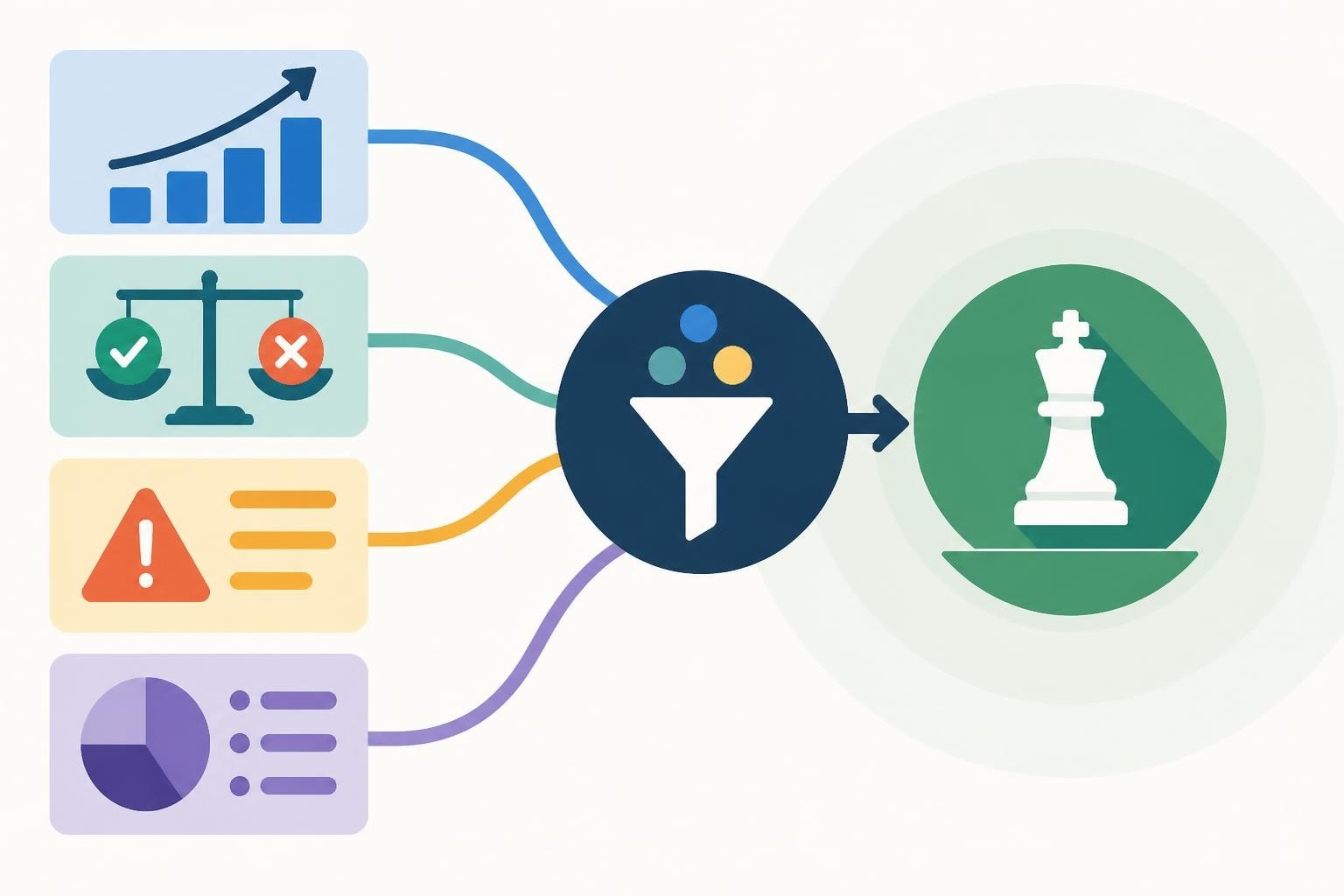
Making critical financial decisions under uncertainty requires more than intuition and experience. Organizations face complex choices involving multiple stakeholders, competing objectives, and incomplete information. This is where decision analysis provides a systematic framework for evaluating alternatives, quantifying risks, and selecting optimal courses of action. For finance professionals working in corporate advisory, gold markets, and risk management, understanding decision analysis methodologies offers a competitive advantage in delivering measurable results for clients.
Understanding the Foundation of Decision Analysis
Decision analysis represents a structured approach to making choices when outcomes are uncertain and stakes are high. The methodology combines quantitative techniques with qualitative judgment to decompose complex problems into manageable components. Unlike intuitive decision-making, this systematic approach creates transparency and reproducibility in how organizations evaluate options.
The Decision Analysis Society defines the field as promoting logical methods for improving decision-making across sectors. For financial advisors, this translates into frameworks that help clients navigate capital allocation, risk mitigation, and strategic planning with greater confidence.
Core Components of the Framework
Every decision analysis contains several fundamental elements working together:
- Decision alternatives: The specific options available to decision-makers
- Uncertain events: External factors that influence outcomes but remain outside direct control
- Consequences: The results arising from each combination of alternatives and uncertain events
- Preferences: The relative value assigned to different possible outcomes
- Information: Data and insights that reduce uncertainty
Financial professionals applying these components to corporate finance scenarios gain clarity about trade-offs. When advising clients on liquidity management or lender readiness, each element requires careful specification to ensure the analysis reflects business reality.

Quantitative Methods in Financial Decision Analysis
Modern decision analysis employs sophisticated quantitative techniques to evaluate alternatives rigorously. These methods transform subjective judgments into mathematical models that facilitate comparison and sensitivity testing.
Decision Trees and Sequential Choices
Decision trees provide visual representations of choices unfolding over time. Each branch represents a possible decision or chance event, with probabilities assigned to uncertain outcomes. For finance advisors working with clients on multi-stage investments or strategic initiatives, decision trees clarify how early choices constrain or enable future options.
The tree structure naturally accommodates sequential decisions common in corporate finance. A company considering expansion might first decide whether to conduct market research, then whether to proceed based on findings, and finally how to structure financing. Each node in the tree represents a decision point with associated costs, benefits, and uncertainties.
| Decision Tree Element | Purpose | Financial Application |
|---|---|---|
| Decision nodes | Represent controllable choices | Capital allocation, financing structure |
| Chance nodes | Represent uncertain events | Market conditions, commodity prices |
| Terminal nodes | Show final outcomes | NPV, IRR, enterprise value |
| Probabilities | Quantify uncertainty | Default risk, price volatility |
Expected Value Calculations
Expected value analysis forms the mathematical core of many decision frameworks. By multiplying each possible outcome by its probability and summing the results, analysts calculate the average result if the decision were repeated many times. While individual outcomes vary, expected value provides a rational basis for choice under uncertainty.
For corporate finance applications, expected value analysis supports capital budgeting decisions, risk assessment, and portfolio management. When evaluating mining projects or commodity hedging strategies, the methodology incorporates both upside potential and downside risk into a single metric.
However, expected value has limitations. It treats all risks equally regardless of magnitude, which may not align with organizational risk tolerance. A decision with high expected value but catastrophic worst-case scenarios might be inappropriate for organizations with limited financial resilience.
Multi-Criteria Decision Analysis for Complex Scenarios
Financial decisions rarely optimize a single objective. Organizations balance profitability against risk, growth against stability, and short-term performance against long-term sustainability. Multi-criteria decision analysis addresses these competing goals systematically.
Structuring Multiple Objectives
The first step involves identifying and organizing relevant criteria. For a gold mining company evaluating expansion options, criteria might include:
- Net present value of cash flows
- Capital requirements and financing costs
- Operational risk and technical complexity
- Regulatory and political risk exposure
- Environmental and social impact
- Strategic alignment with core competencies
Each criterion requires clear definition and measurement. Ambiguous objectives lead to inconsistent evaluation and unreliable conclusions. Financial advisors working with clients on governance and risk solutions must ensure all stakeholder perspectives receive appropriate representation in the criteria structure.
Weighting and Scoring Approaches
Once criteria are defined, analysts assign weights reflecting their relative importance. Various methods exist, from simple ranking to sophisticated analytical hierarchy processes. The choice depends on stakeholder availability, decision complexity, and required precision.
After weighting, each alternative receives scores on individual criteria. Some criteria allow objective measurement like financial returns or capital costs. Others require subjective judgment, such as strategic fit or organizational readiness. The development of decision analysis methodologies has produced numerous techniques for eliciting reliable judgments from subject matter experts.
Recent research on sentiment analysis-based decision-making demonstrates how natural language processing can extract preferences from unstructured data, expanding the information available for multi-criteria analysis. While developed for consumer choices, similar techniques could analyze stakeholder communications or market sentiment in financial contexts.
Risk Assessment and Sensitivity Analysis
Uncertainty pervades financial decision-making. Interest rates fluctuate, commodity prices swing, and competitive dynamics evolve. Effective decision analysis incorporates these uncertainties explicitly rather than ignoring them or reducing them to single-point estimates.
Probability Assessment Techniques
Assigning probabilities to uncertain events requires both data and judgment. Historical frequencies provide starting points for recurring events like market volatility or credit defaults. For unique situations without historical precedent, expert elicitation techniques extract probability judgments from knowledgeable individuals.
Common probability assessment methods include:
- Direct assessment: Experts state probabilities based on experience
- Comparison to reference events: Experts compare the uncertain event to situations with known probabilities
- Probability encoding: Structured interviews transform qualitative statements into numerical probabilities
- Scenario analysis: Multiple futures are developed with associated likelihoods
Financial professionals must recognize and mitigate cognitive biases affecting probability judgment. Overconfidence, anchoring, and availability bias systematically distort assessments. Structured elicitation protocols and calibration training improve reliability.

Tornado Diagrams and Value of Information
Sensitivity analysis identifies which uncertainties most significantly affect the preferred decision. Tornado diagrams display the impact of varying each uncertain parameter across its plausible range, with the most influential factors appearing at the top.
For liquidity management decisions, sensitivity analysis might reveal that interest rate assumptions drive results more than revenue growth projections. This insight focuses attention on hedging interest rate risk or obtaining better forecasts for that specific variable.
The value of information analysis quantifies the benefit of reducing specific uncertainties. If additional market research, geological surveys, or financial modeling would cost less than the expected value of the information gained, the investment proves worthwhile. This framework helps finance advisors allocate analytical resources efficiently when supporting client decisions.
Implementing Decision Analysis in Financial Advisory
Theoretical frameworks deliver value only through practical application. Financial advisory firms integrating decision analysis into client engagements must address implementation challenges while maintaining analytical rigor.
Stakeholder Engagement and Communication
Decision analysis succeeds when stakeholders understand and trust the process. Complex models and technical jargon create barriers rather than insights. Effective implementation requires translating analytical results into business language that resonates with executives and board members.
Visual representations prove particularly valuable. Decision trees, tornado diagrams, and risk profiles communicate insights more effectively than tables of numbers. Interactive models allowing stakeholders to explore scenarios build ownership and confidence in recommendations.
The Decision Analysis journal publishes research on practical applications across industries, providing examples of successful implementations and lessons learned. Finance professionals can adapt methodologies from other sectors to corporate finance contexts.
Software and Analytical Tools
Modern decision analysis relies on specialized software supporting model development, probability assessment, and sensitivity analysis. Tools range from spreadsheet add-ins to comprehensive decision support platforms. The MCDA Methods Selection Software assists analysts in choosing appropriate techniques for specific problem types, improving methodological rigor.
For financial advisory applications, software should integrate with existing financial models and data sources. Seamless connections between decision models and accounting systems, market data feeds, and risk management platforms reduce manual effort and improve accuracy.
| Software Capability | Benefit | Advisory Application |
|---|---|---|
| Scenario modeling | Test multiple futures | Strategic planning, capital allocation |
| Monte Carlo simulation | Quantify aggregate uncertainty | Portfolio risk, project valuation |
| Optimization algorithms | Identify best solutions | Asset allocation, hedging strategies |
| Collaboration features | Enable stakeholder input | Governance decisions, board reporting |
Advanced Applications in Corporate Finance
Decision analysis extends beyond individual project evaluation to enterprise-level strategic choices. Financial advisors working with sophisticated clients apply these methodologies to portfolio optimization, strategic planning, and organizational design.
Real Options Analysis
Traditional capital budgeting treats investment decisions as now-or-never propositions. Real options analysis recognizes that managers retain flexibility to adjust strategies as uncertainty resolves. The option to defer investment, expand capacity, or abandon projects has quantifiable value.
For gold industry clients, real options analysis values the flexibility inherent in mining operations. Mines can be temporarily closed when gold prices fall below operating costs, then reopened when prices recover. This operational flexibility increases project value beyond what static NPV calculations suggest.
The methodology applies financial option pricing theory to physical assets. While technically demanding, real options analysis provides insights unavailable through conventional approaches. Resources like educational videos on decision analysis help practitioners understand and apply these techniques.
Group Decision-Making Dynamics
Many financial decisions involve multiple stakeholders with divergent preferences. Board members, management teams, and investor groups may disagree about priorities and acceptable risks. Research on the value of agreement in decision analysis quantifies benefits from achieving consensus versus proceeding despite disagreement.
Structured decision processes help groups navigate disagreements productively. By separating facts from values and making trade-offs explicit, facilitated decision analysis sessions build shared understanding even when preferences differ. For governance-focused advisory work, these processes strengthen board effectiveness and stakeholder alignment.

Integrating Decision Analysis with Financial Advisory Services
For advisory firms specializing in corporate finance and risk solutions, decision analysis methodologies complement traditional financial expertise. The structured approach enhances service delivery across practice areas.
Lender Readiness and Capital Structure
Preparing clients for financing relationships requires demonstrating creditworthiness and financial resilience. Decision analysis frameworks help clients develop credible financial projections incorporating realistic uncertainty ranges. Lenders value transparent risk assessment showing management understands potential challenges.
When advising on capital structure decisions, decision analysis explicitly trades off benefits like tax shields and financial flexibility against costs including distress risk and agency problems. Multi-criteria frameworks accommodate qualitative factors like relationship preservation and covenant flexibility alongside quantitative metrics.
Liquidity Management and Working Capital
Effective liquidity management balances opportunity costs of holding excess cash against risks of financial distress. Decision analysis models incorporate uncertain cash flow timing, working capital variability, and financing availability to determine optimal cash reserves and credit facility sizing.
Scenario analysis tests liquidity adequacy across plausible stress situations. By quantifying the probability and severity of liquidity shortfalls under various scenarios, advisors help clients establish appropriate buffers and contingency plans.
Risk Solutions and Hedging Strategy
Commodity price volatility, foreign exchange exposure, and interest rate risk require sophisticated hedging strategies. Decision analysis frameworks evaluate hedging alternatives considering costs, effectiveness, and basis risk. The methodology accommodates complex derivatives and structured products while maintaining transparency about risk-return trade-offs.
For gold industry clients, hedging strategies must balance protecting downside risk against preserving upside participation. Decision trees modeling sequential hedging decisions as prices evolve help identify dynamic strategies superior to static approaches. Organizations like AurumCrest Advisory leverage these analytical frameworks to deliver practical risk solutions aligned with client objectives.
Building Organizational Capability
Sustained value from decision analysis requires organizational capability beyond individual project applications. Financial advisory firms and their clients benefit from developing systematic decision processes and analytical competencies.
Training and Knowledge Development
Decision analysis skills combine technical expertise with business judgment. Training programs should address both dimensions, covering quantitative methods while developing intuition about when different techniques apply. Case studies from relevant industries make concepts concrete and demonstrate practical value.
For finance teams, proficiency with decision analysis tools and software enables rapid response to emerging opportunities and challenges. Rather than outsourcing every analysis, organizations with internal capability can perform routine evaluations while engaging advisors for complex or high-stakes decisions.
Decision Governance and Documentation
Formal decision processes create accountability and enable organizational learning. Documented decision rationales facilitate post-decision reviews examining what assumptions proved accurate and which decisions delivered expected results. This feedback loop continuously improves decision quality.
Governance structures specify who makes different types of decisions, what analysis is required, and how stakeholders participate. Clear authority and process reduce decision delays while ensuring appropriate oversight. For advisory clients focused on governance improvement, decision analysis provides frameworks for designing effective decision rights and processes.
Decision analysis transforms financial decision-making from art to science, providing systematic frameworks that improve outcomes under uncertainty. By integrating quantitative methods with expert judgment, the approach delivers transparency, consistency, and confidence in strategic choices. Whether evaluating capital investments, managing liquidity, or designing risk solutions, finance professionals equipped with decision analysis capabilities serve clients more effectively. AurumCrest Advisory combines decision analysis methodologies with over 30 years of corporate finance and gold industry experience to deliver practical solutions that enhance financial resilience and control for organizations facing complex strategic choices.