
Organizations face an increasingly complex landscape of threats in 2026, from cybersecurity vulnerabilities and regulatory changes to market volatility and operational disruptions. Business risk assessments have become essential tools for identifying, evaluating, and prioritizing these threats before they materialize into costly crises. Whether you're managing liquidity concerns, preparing for lender negotiations, or strengthening governance frameworks, a systematic approach to risk assessment provides the foundation for resilient decision-making and long-term financial stability.
Understanding the Foundations of Business Risk Assessments
Business risk assessments represent a structured methodology for identifying potential threats to your organization's objectives, assets, and operations. These evaluations examine vulnerabilities across financial, operational, strategic, and compliance dimensions to create a comprehensive picture of your risk landscape.
The assessment process moves beyond simple checklists to analyze how different risks interact and compound. A liquidity shortage might simultaneously trigger covenant violations, damage lender relationships, and limit strategic options. Understanding these interconnections allows leadership teams to prioritize mitigation efforts where they deliver maximum protective value.
Key Components of Effective Risk Identification
Financial institutions and advisory firms must consider multiple risk categories:
- Credit risk from counterparty defaults or deteriorating loan portfolios
- Market risk from commodity price fluctuations, interest rate changes, or currency volatility
- Operational risk from process failures, technology breakdowns, or human error
- Compliance risk from regulatory violations or governance lapses
- Reputational risk from client dissatisfaction, media scrutiny, or ethical breaches
- Strategic risk from poor planning, competitive pressure, or market disruption
Each category requires specialized assessment techniques. For gold industry participants, commodity price volatility demands particular attention, while firms managing client assets must prioritize fiduciary and compliance risks. The FINRA approach to member firm risk assessments provides valuable frameworks for financial service providers evaluating their risk profiles.

Risk Assessment Methodologies and Frameworks
Selecting the appropriate methodology determines the quality and usefulness of your risk assessment outcomes. Different frameworks suit different organizational contexts, complexity levels, and resource constraints.
Quantitative Assessment Approaches
Quantitative methods assign numerical values to probability and impact, creating measurable risk scores. This approach enables objective comparison between disparate risks and supports data-driven prioritization.
| Methodology | Best For | Key Advantage | Primary Limitation |
|---|---|---|---|
| Monte Carlo Simulation | Complex financial modeling | Accounts for uncertainty ranges | Requires extensive historical data |
| Value at Risk (VaR) | Market and credit risk | Industry-standard metric | May underestimate tail risks |
| Expected Loss Calculation | Credit portfolios | Clear financial impact | Assumes stable probabilities |
| Sensitivity Analysis | Strategy evaluation | Tests multiple scenarios | Doesn't capture interaction effects |
Quantitative assessments excel when you have:
- Sufficient historical data to model probability distributions
- Clear financial metrics for measuring impact
- Systems capable of processing complex calculations
- Stakeholders comfortable interpreting statistical outputs
The CMS risk assessment guidance emphasizes the importance of appropriate methodology selection based on organizational capabilities and information security requirements.
Qualitative Assessment Techniques
Qualitative approaches use descriptive categories rather than precise numbers, making them accessible when data limitations exist or when assessing emerging risks without historical precedent.
These methods typically employ matrices rating risks as low, medium, or high across likelihood and impact dimensions. While less precise than quantitative methods, qualitative assessments facilitate broader participation from stakeholders who may lack statistical expertise but possess valuable institutional knowledge.
Workshop-based assessments bring together cross-functional teams to:
- Brainstorm potential risk scenarios through structured facilitation
- Evaluate likelihood based on collective experience and industry knowledge
- Estimate impact using organizational understanding of vulnerabilities
- Identify existing controls and their effectiveness
- Develop mitigation recommendations aligned with risk tolerance
The LegalClarity risk assessment methodology offers practical frameworks for identifying and scoring risks across various business contexts.
Implementing Business Risk Assessments in Financial Advisory Contexts
Financial advisory firms face unique risk profiles requiring specialized assessment approaches. The combination of fiduciary responsibilities, regulatory scrutiny, and market dependencies creates a complex environment where comprehensive business risk assessments become critical.
Regulatory Compliance and Governance Risks
Regulatory requirements continue expanding in 2026, creating multiple compliance obligations:
- Anti-money laundering (AML) surveillance and reporting
- Know Your Customer (KYC) verification and ongoing monitoring
- Data privacy protections under evolving legislation
- Capital adequacy and liquidity requirements
- Conflicts of interest management and disclosure
The UK government guidance on money laundering risk assessments provides detailed frameworks for evaluating compliance risks in financial services. Similarly, FINTRAC's risk-based approach outlines methodologies for assessing money laundering and terrorist financing risks applicable across jurisdictions.

Lender and Counterparty Risk Assessment
Organizations dependent on credit facilities or engaged in commodities trading must rigorously assess counterparty risks. Business risk assessments in this domain examine financial stability, contractual performance history, and systemic exposure.
Evaluation criteria include:
- Credit ratings and financial statement analysis
- Industry position and competitive vulnerabilities
- Geographic and political risk exposures
- Relationship concentration and diversification needs
- Covenant structures and trigger thresholds
For gold industry participants, counterparty assessment extends to refiners, vaults, logistics providers, and hedging partners. A comprehensive view captures the entire value chain's resilience against disruption.
Integrating Risk Assessments into Strategic Decision-Making
Business risk assessments deliver maximum value when integrated into strategic planning, capital allocation, and operational management rather than existing as standalone compliance exercises.
Liquidity and Capital Planning
Liquidity risk represents one of the most acute threats to organizational survival. Even profitable firms fail when unable to meet immediate obligations. Effective business risk assessments model cash flow scenarios under various stress conditions.
| Scenario | Revenue Impact | Cost Behavior | Liquidity Requirement | Mitigation Priority |
|---|---|---|---|---|
| Commodity Price Decline | -30% | Fixed costs remain | Immediate facility draw | High |
| Client Concentration Loss | -45% | Partial cost reduction | Emergency reserves | Critical |
| Regulatory Fine | Neutral | One-time expense | Secondary facility | Medium |
| Market Volatility Spike | Variable | Minimal change | Maintain buffer | Medium-High |
Stress testing across multiple dimensions reveals vulnerabilities before they manifest. Organizations can then secure appropriate credit facilities, adjust covenant structures, or restructure operations to enhance resilience. AurumCrest Advisory specializes in helping organizations develop lender-ready positions through comprehensive liquidity analysis and covenant optimization.
Governance and Control Environment Assessment
Strong governance creates the foundation for effective risk management. Business risk assessments should evaluate whether organizational structures, reporting lines, and control frameworks align with risk exposures.
Critical governance elements include:
- Clear risk ownership and escalation protocols
- Board-level risk oversight and expertise
- Independent verification and audit functions
- Whistleblower protections and ethical culture
- Information flow and management reporting quality
Governance weaknesses compound other risks by delaying detection, limiting response options, and reducing stakeholder confidence. The Australian Government's guidance on risk management plans offers practical frameworks for establishing robust governance structures aligned with risk profiles.
Developing and Maintaining Risk Registers
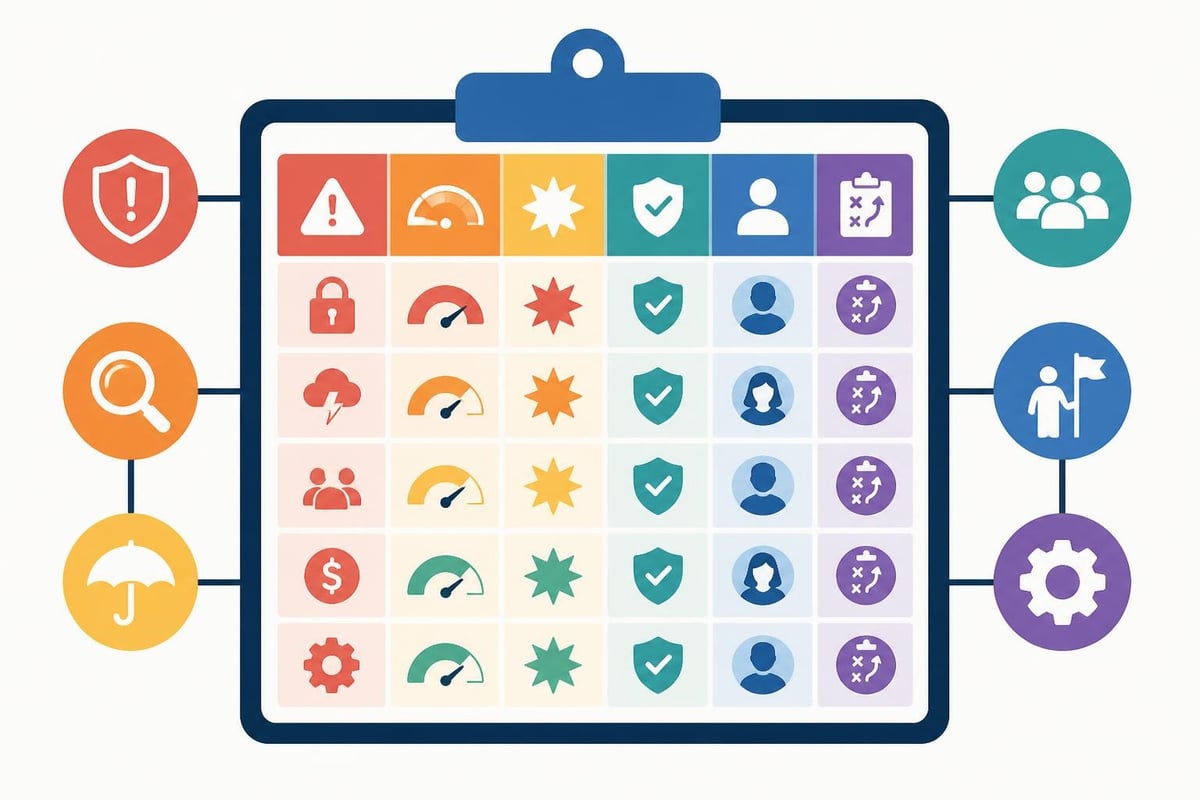
Risk registers provide centralized documentation of identified risks, their assessments, control measures, and ownership assignments. These living documents evolve as organizations learn from incidents, market conditions shift, and new threats emerge.
Essential Register Components
Each risk entry should capture:
- Risk description: Clear articulation of the threat and its potential triggers
- Category classification: Financial, operational, compliance, strategic, or reputational
- Likelihood rating: Probability of occurrence within defined timeframes
- Impact assessment: Potential consequences across financial, operational, and reputational dimensions
- Inherent risk score: Severity before considering existing controls
- Current controls: Existing measures reducing likelihood or impact
- Residual risk score: Remaining exposure after control effectiveness
- Risk owner: Individual accountable for monitoring and mitigation
- Action plans: Additional measures to reduce residual risk
- Review frequency: How often assessments are updated
Dynamic Risk Monitoring
Static assessments rapidly lose relevance in dynamic business environments. Effective programs establish regular review cycles tied to business planning, audit schedules, and triggering events.
Review frequency should increase for:
- High residual risk exposures exceeding tolerance thresholds
- Risks in volatile categories like market or regulatory domains
- Areas with recent incidents or near-misses
- Operations undergoing significant change or expansion
Quarterly formal reviews typically provide sufficient currency for most risk categories, while critical risks may warrant monthly monitoring with real-time metrics tracked continuously.
Risk Mitigation Strategies and Control Design
Identifying risks represents only the first step. Business risk assessments must translate into concrete mitigation strategies that reduce exposures to acceptable levels.
The Four T's of Risk Response
Organizations can respond to identified risks through four primary strategies:
- Treat: Implement controls reducing likelihood or impact
- Transfer: Shift risk to third parties through insurance, hedging, or outsourcing
- Tolerate: Accept risks within tolerance with ongoing monitoring
- Terminate: Eliminate activities creating unacceptable exposures
The appropriate response depends on risk severity, mitigation costs, and strategic importance of the underlying activity. A comprehensive business risk assessment guide outlines practical approaches for selecting and implementing appropriate risk responses.
Control Effectiveness Evaluation
Controls provide value only when properly designed and consistently executed. Business risk assessments should evaluate whether existing controls actually reduce risks or merely create compliance burdens without substantive protection.
Effective controls demonstrate:
- Clear documentation of procedures and responsibilities
- Preventive mechanisms stopping risks before occurrence
- Detective capabilities identifying breaches promptly
- Appropriate separation of duties preventing single-point failures
- Regular testing validating operational effectiveness
- Technology enablement improving consistency and scalability
Control gaps emerge from inadequate design, inconsistent execution, or changing circumstances that render previously effective measures obsolete. Regular control testing within business risk assessments identifies these gaps before they result in losses.
Industry-Specific Considerations for Financial Advisory Firms
Financial advisory practices operate under unique pressures requiring tailored risk assessment approaches. The combination of fiduciary duties, market volatility, and regulatory complexity creates distinctive risk profiles.
Client Concentration and Revenue Volatility
Many advisory firms depend heavily on a small number of significant client relationships. This concentration creates substantial revenue risk if key clients depart or reduce engagement.
| Concentration Level | Annual Revenue Risk | Mitigation Priority | Recommended Actions |
|---|---|---|---|
| Single client >40% | Critical | Immediate | Diversification plan, contract extension |
| Top 3 clients >60% | High | Urgent | Client development, service expansion |
| Top 5 clients >75% | Elevated | Important | Relationship deepening, referral programs |
| Diverse portfolio | Manageable | Ongoing | Continuous development, retention focus |
Business risk assessments should model revenue scenarios assuming loss of top clients, incorporating realistic timeframes for replacement. This analysis informs business development investments, pricing strategies, and reserve requirements.
Market and Commodity Price Exposures
Advisory firms serving gold industry clients or managing commodity-linked portfolios face direct and indirect price risk. Direct exposures arise from inventory holdings or hedging positions, while indirect risks emerge through client financial stress affecting fee revenue.
Comprehensive business risk assessments model how commodity price movements flow through the business model, affecting client profitability, advisory demand, and transaction volumes. This understanding enables proactive positioning ahead of market shifts rather than reactive scrambling during crises.
Building Risk-Aware Organizational Cultures
Technical risk assessment processes deliver limited value without corresponding cultural commitment to risk awareness and proactive management. Leadership teams must champion risk consciousness throughout organizations.
Communication and Training Programs
Effective risk culture requires:
- Regular communication of risk assessment findings to all stakeholders
- Training programs building risk literacy across management levels
- Incentive structures rewarding prudent risk-taking and issue escalation
- Transparent discussion of failures and near-misses without blame
- Integration of risk considerations into strategic planning and operations
When employees understand organizational risk priorities and their roles in mitigation, they become active participants in risk management rather than passive compliance checkers.
Continuous Improvement Processes
Business risk assessments should evolve based on lessons learned from incidents, control testing results, and changing external environments. Organizations that treat assessments as annual compliance exercises miss opportunities for genuine improvement.
Continuous enhancement involves:
- Post-incident reviews identifying assessment gaps or control failures
- Emerging risk scanning monitoring industry trends and regulatory changes
- Peer benchmarking comparing practices against industry standards
- Technology adoption leveraging automation for monitoring and analysis
- Stakeholder feedback incorporating diverse perspectives on risk landscape
This learning orientation transforms business risk assessments from static documents into dynamic management tools that genuinely enhance organizational resilience and decision-making quality.
Business risk assessments provide the foundation for resilient operations and informed decision-making in an increasingly complex business environment. By systematically identifying vulnerabilities, evaluating their potential impact, and implementing targeted mitigation strategies, organizations protect themselves against preventable losses while positioning for sustainable growth. AurumCrest Advisory brings over 30 years of experience helping organizations strengthen their risk management frameworks, enhance lender readiness, and build governance structures that support long-term financial resilience. Connect with our team to develop customized risk solutions aligned with your strategic objectives and operational realities.